Why Experience Alone Isn't Enough in Aseptic Processing
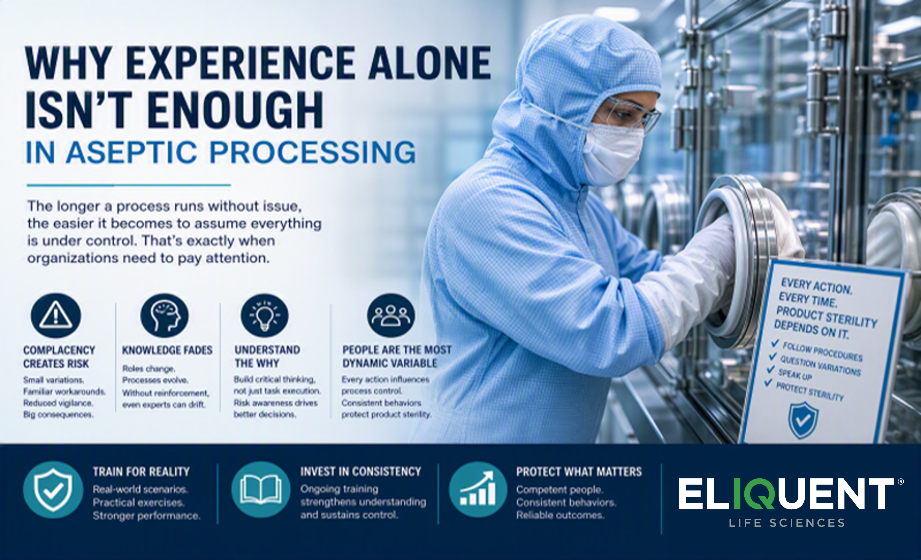
The longer a process runs without issue, the easier it becomes to assume everything is under control. That’s exactly when organizations need to pay attention.
In a previous blog, we explored how aseptic processing depends on the alignment of systems, environments, and people. Procedures matter. Controlled environments matter. Equipment matters.
But when contamination events occur, investigations often uncover a familiar reality:
The controls existed.
The procedures were documented.
The equipment functioned as designed.
The breakdown occurred somewhere in the execution.
The Hidden Risk of Routine
Most contamination risks are not created by dramatic failures. More often, they emerge from small variations in everyday activities:
A gloved hand briefly interrupting first air during an intervention
A material transfer performed slightly differently than the approved technique
Disinfection contact times shortened to maintain production pace
A routine intervention taking place outside the conditions originally assessed during qualification
An operator adopting a workaround because “it has never caused a problem before”
The challenge is these behaviors rarely appear overnight. They develop gradually as familiarity increases and vigilance decreases.
In highly controlled environments, comfort can become a risk factor.
Knowledge Fades Faster Than Organizations Realize
Training is commonly viewed as a qualification event, a prerequisite for entering the cleanroom or supporting aseptic operations.
However, qualifications alone do not guarantee sustained performance.
People change roles. Processes evolve. Facilities adopt new technologies. Regulatory expectations continue to develop. Even experienced personnel can drift from established practices over time.
Without reinforcement, knowledge gaps can appear where organizations least expect them.
Ironically, some of the greatest risks appear among highly experienced personnel. Familiarity creates efficiency, confidence, and technical competence. It can also reduce the tendency to question established practices.
The risk is not lack of knowledge.
The question is not whether employees were trained.
The more important question is whether critical concepts remain consistently understood and applied months—or years—later.
Beyond Procedures: Building Critical Thinking
Strong aseptic programs do more than teach people what to do.
They help personnel understand:
Why specific controls exist
How contamination pathways develop
What conditions increase risk
How individual actions influence product sterility
When people understand the reasoning behind procedures, they are better equipped to identify issues before they become deviations.
That shift—from task execution to risk awareness—is often what separates compliance from operational excellence.
The Human Element Remains the Most Dynamic Variable
Facilities can be designed to reduce contamination risks. Equipment can be qualified. Environmental conditions can be monitored.
People, however, remain dynamic.
Every intervention, every material transfer, every movement within a controlled environment introduces an opportunity to either maintain or challenge process control.
This is why continued development of aseptic behaviors is so important.
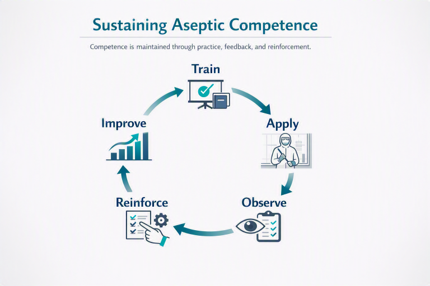
Organizations that perform well over the long term recognize that competence is not a fixed achievement. It is a capability that must be maintained through continuous reinforcement and practical application.
Training Should Reflect Reality
The most effective learning experiences do not happen in isolation from the workplace.
Real-world scenarios, interactive discussions, case studies, and practical exercises help personnel connect principles to day-to-day decisions.
When participants can see how contamination risks emerge in realistic situations, training becomes more than information transfer—it becomes performance reinforcement.
And that is often where the greatest value is found.
Investing in Consistency
Many aseptic operations appear stable until they are challenged.
What determines the outcome is rarely a single procedure or piece of equipment. More often, it is the collective understanding of the people responsible for maintaining control.
Organizations that invest in ongoing training are not simply checking a compliance box.
They are investing in consistency.
In an environment where even small deviations can have significant consequences, that investment can make all the difference.
Learn More
ELIQUENT Life Sciences offers training and consulting focused on aseptic processing, contamination control, cleanroom behaviors, and sterile manufacturing operations.
Explore ELIQUENT’s aseptic processing training offerings to learn more about building and sustaining the knowledge and behaviors that support effective contamination control.