

QA/RA Consulting, Auditing & Training
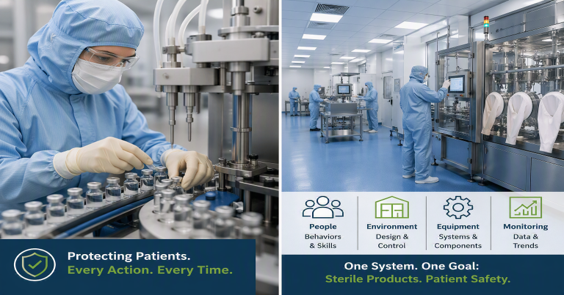
In sterile manufacturing, there’s no such thing as a small mistake—only small signals that get missed until they become major failures.
Aseptic processing sits at the center of that reality. It’s where product, environment, equipment, and human behavior converge. And while most organizations have defined procedures in place, many still treat aseptic processing as a checklist rather than what it truly is: a system that depends on consistent execution across multiple controls.
And that’s where teams can get caught off guard. Not because controls don’t exist—but because consistency is often assumed where variability still resides.
In many cases, aseptic failures are not the result of missing controls, but of variability within controls that appear to be working.
Producing sterile pharmaceuticals is not just a technical requirement—it is one of the most direct ways manufacturing decisions influence patient safety.
That distinction matters. When individuals understand why aseptic controls exist, they are more likely to recognize risk, make informed decisions, and respond appropriately when conditions change.
Without that foundation, even well-structured procedures can break down in practice.
Aseptic processing is not a single task, it’s a full workstream.
From understanding when aseptic processing is appropriate, to navigating regulatory expectations, to managing filling systems and container closures, each element is connected. When one part weakens, the impact carries forward.
Organizations that perform well don’t just train on individual tasks. They build understanding around how each step contributes to overall process control—and where risk can accumulate.

Contamination control doesn’t belong to a single team or activity. It is the result of multiple controls working together.
Cleaning and disinfection, environmental controls, facility design, and process flow all play a role—but they only work when consistently applied in real-world conditions.
Ask a simple question across your operation:
Can every team member clearly explain where contamination risk is most likely to enter your process—and why?
If the answer varies, so does your level of control. Remember: the absence of contamination is not the same thing as proof of control.
Cleanrooms and controlled environments are essential—but classifications alone don’t ensure control. A classified environment creates the conditions for control. It does not guarantee that control is being maintained.
What matters is how those environments are used. Personnel movement, material transfer, and management of critical surfaces all influence whether contamination risks are effectively controlled.
In practice, it’s the interaction between people and environment that determines performance.
Environmental monitoring is often treated as a compliance requirement, but it can offer much more.
Monitoring provides a window into process stability. It highlights trends, reveals emerging issues, and indicates whether controls are holding—or beginning to drift.
The value isn’t just in collecting data. It’s in recognizing when the system is beginning to behave differently than expected—and acting on it before minor variation becomes a larger issue.
Ask where the greatest aseptic risk lives, and the answer is rarely equipment—it’s variability in human behavior.
How individuals move, interact with equipment, and maintain first air can preserve sterility—or compromise it in seconds.
These are not just technical skills. They require awareness, discipline, and reinforcement over time. Training that focuses only on what to do misses the opportunity to build understanding around why it matters.
Aseptic process simulations provide one of the clearest views into whether controls are truly effective.
They test systems, procedures, and people under realistic and worst-case conditions. More importantly, they reveal how processes perform under pressure, and where assumptions may not hold.
Many aseptic processes appear stable—until they’re challenged. The difference often lies not in system design, but in how well risks are understood and managed in real time.
Aseptic processing works when systems, environments, and people operate in alignment—not just on paper, but in day-to-day execution. However, as routine becomes familiar, the risk of complacency increases—making ongoing training and reinforcement essential to keep awareness sharp and ensure critical controls are consistently understood and applied.
The question is not whether aseptic controls exist. The question is whether they are performing consistently enough to maintain control when conditions are less than ideal.
If your team is working in or supporting sterile manufacturing, it’s worth taking a closer look at how consistently these principles are understood and applied across your operation.
ELIQUENT offers training and advisory support in aseptic processing and contamination control to help teams strengthen both foundational knowledge and practical execution. Learn more about available support and upcoming training sessions

US Office Washington DC

Lorem ipsum dolor sit amet, consectetur adipiscing elit. Ut elit tellus, luctus nec ullamcorper mattis, pulvinar dapibus leo.