
QA/RA Consulting, Auditing & Training
Artificial intelligence often gets described as “just another tool”: Something to deploy, validate, and fold into existing processes alongside other software systems. And that framing works – right up until AI starts behaving in ways those processes weren’t designed to handle.
Unlike traditional software, AI systems don’t simply execute fixed logic. They learn from data. They respond to context. Over time, they can behave differently than they did at deployment, even when no one has formally changed a requirement or touched the code. Outputs that once looked stable can drift. Decisions that once felt straightforward can become harder to explain.
For organizations used to managing risk through well‑defined controls, this can be uncomfortable territory.
Most quality and management systems are built on an assumption of relative stability. Once something is reviewed, approved, and released, the expectation is that it will continue to behave in a known way unless a formal change is introduced.
AI challenges that assumption. As data sources evolve, usage expands, or operating conditions shift, AI systems may begin to behave differently. Sometimes the change is obvious, but more often it’s subtle: A result looks slightly off; a trend starts to look different than expected; someone notices something that doesn’t necessarily merit an investigation but doesn’t feel quite right either.
Handled individually, each of these moments seems manageable: Address the issue. Adjust the model. Update the documentation. Move on.
Over time, though, teams can find themselves stuck in a reactive cycle – playing whack‑a‑mole, responding to one issue after another without ever addressing why those issues keep emerging in the first place.
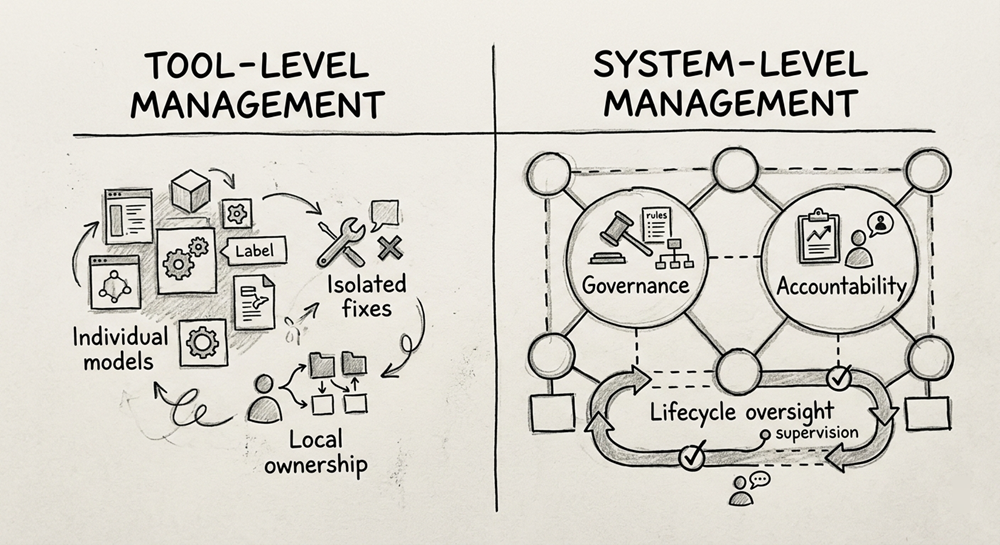
When AI is managed strictly at the tool or use‑case level, oversight becomes scattered. Responsibility gets distributed across teams. Decisions are made locally. Patterns become visible only after the fact.
This isn’t a failure of effort or intent. It’s a mismatch between how AI behaves and how it’s being managed.
Traditional controls work best for systems that are largely static. AI systems are not: They evolve as data, context, and use change. Without a broader structure in place, organizations often end up managing symptoms rather than causes – fixing what’s visible while missing what’s systemic.
A more sustainable approach starts by stepping back.
Instead of focusing exclusively on individual models or tools, organizations begin to think about AI as something that needs to be managed as a system with clear accountability, consistent oversight, and defined ways of understanding how behavior changes over time.
That’s usually when organizations step back and start asking different questions:
These aren’t technology questions; they’re management questions, and they tend to be the ones organizations struggle with most once AI use begins to expand.
AI is moving quickly into areas that directly affect quality, safety, and decision making – from development and manufacturing to postmarket activities. At the same time, expectations around transparency and accountability are increasing.
Organizations that rely on ad hoc fixes often find themselves working harder just to keep pace. Those that take a more deliberate, system level approach are better positioned to see patterns early, align AI use with organizational objectives, and adapt as conditions change.
The objective isn’t to remove uncertainty, because AI will always introduce some. Instead, the goal is to manage that uncertainty intentionally rather than reactively.
As organizations start taking a more system‑level approach to AI, some look for ways to bring structure and consistency to that effort. One example is ISO/IEC 42001, an AI management system standard focused on governance, accountability, and ongoing oversight across the AI lifecycle.
The value of an approach like this isn’t the standard itself. Rather, it’s the discipline the standard reinforces, treating AI as something that needs to be managed deliberately, over time, and across the organization, rather than handled one issue at a time.
As we’ve noted, AI doesn’t sit still. Managing it effectively requires an approach that recognizes this reality.
Organizations that move beyond tool‑by‑tool thinking aren’t adding unnecessary structure. They’re creating clarity – replacing reactive responses with intentional oversight and building management practices that can evolve alongside the technology itself. That’s the difference between chasing problems and managing a system.
Interested in building foundational understanding?
ELIQUENT Life Sciences offers virtual and instructor‑led training on AI in Management Systems (ISO/IEC 42001), focused on system‑level governance and integration with existing management frameworks.
Need help applying this at your organization?
ELIQUENT also provides consulting and advisory support to help organizations assess current AI use, design practical governance structures, and integrate AI management into established quality and management systems and submissions support along with ongoing assessment.
Contact ELIQUENT to start a conversation.

US Office Washington DC

Lorem ipsum dolor sit amet, consectetur adipiscing elit. Ut elit tellus, luctus nec ullamcorper mattis, pulvinar dapibus leo.