

QA/RA Consulting, Auditing & Training
Under the FDA’s Quality Management System Regulation (QMSR), that distinction is getting harder to ignore.
As inspections evolve, the question isn’t just whether risk is documented. Instead, it’s whether your approach to risk is actually driving how your system operates – how you prioritize processes, allocate resources, and respond to problems.
That’s the danger lurking inside ISO 13485 clause 4.1.2(b): organizations are expected to apply a risk-based approach to how QMS processes are controlled.
Not describe it. Not reference it. Apply it.
And that’s where many systems start to break down.
ISO 13485 doesn’t treat risk like a side project, but instead regards it as the thing that’s supposed to drive the system.
The process approach already assumes you:
That part isn’t new. What gets missed is what comes next: risk-based thinking is supposed to:
That last piece is where things usually fall apart, because applying a risk-based approach doesn’t mean adding another form or spreadsheet – it means your system stops behaving the same way everywhere.
A risk-based QMS isn’t just controlled. It actually treats some things like they matter more than others.
Most organizations don’t struggle to talk about risk. They struggle to factor it in without making the system feel uneven. Because of this, everything gets standardized:
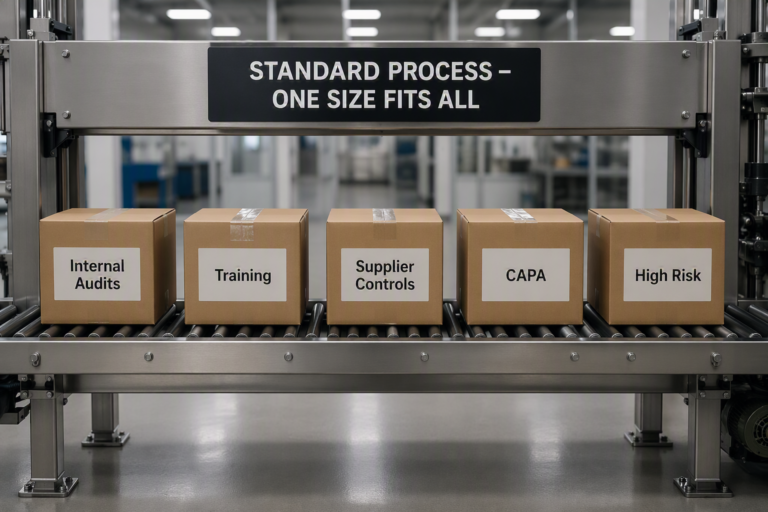
Clean. Consistent. Easy to explain. Also – usually wrong. Treating everything the same isn’t control. It’s hesitation.
Because once you take risk seriously, you have to make decisions that people don’t love:
That’s not tidy. It doesn’t always look great in a procedure. But that friction? That unevenness? That’s usually where you can tell the system is actually thinking.
A risk-based audit program doesn’t run just because something is “due.” It focuses on:
Less “we audit this every year.” More “we pay attention where it would hurt if we didn’t.”
Training is one of the easiest places to spot whether risk is truly being used or just mentioned, because a lot of systems still rely on:
That’s fine for low-risk work, but it’s harder to defend when:
Not all work carries the same consequence. If your training approach doesn’t reflect that, risk isn’t influencing the system. It’s just there in the background.

Some suppliers matter a lot; others really don’t. But if the controls look identical, the system isn’t showing any real judgment.
A risk-based system doesn’t treat suppliers the same. It treats them differently on purpose.
Most systems already say the right things about risk. That’s rarely the issue. The problem is when those statements:
A risk-based QMS is defined by what it does differently, such as where it:
Those differences are the signal the QMS is truly risk-based.
Want to know if your system is really risk based? Ask:
If the answer is “everything looks pretty much the same” then risk probably isn’t driving much of anything.
And if risk doesn’t change your controls, your priorities, or your decisions… it’s not embedded in your QMS. It’s just along for the ride.
Clause 4.1.2(b) isn’t asking whether you can describe risk – it’s addressing whether risk actually changes how your system behaves. Because when it does:
If risk doesn’t change what you do, then you’re not applying a risk-based approach.
You’re just talking about one.
ELIQUENT Life Sciences (formerly Oriel STAT A MATRIX) offers training and support in areas where risk-based thinking becomes visible in practice: internal auditing, CAPA, supplier quality, and inspection readiness.
Explore ways in which your organization can strengthen how risk shows up in day-to-day quality decisions.

US Office Washington DC

Lorem ipsum dolor sit amet, consectetur adipiscing elit. Ut elit tellus, luctus nec ullamcorper mattis, pulvinar dapibus leo.