FDA’s transition to the Quality Management System Regulation (QMSR) isn’t just a paperwork exercise. While the alignment with ISO 13485 is old news, the real concern for manufacturers isn’t in the logic of risk – it’s in the evidence. Simply performing risk management activities is no longer enough: manufacturers must be able to show how risk‑based thinking actively shapes their quality system.
FDA will not be satisfied seeing risk buried in a static file – they want to see it operationalized. They’re asking: Is this control here because a spreadsheet said so three years ago, or because it’s actively protecting the patient today?
QMSR Demands a System-Level View
Although QMSR doesn’t change the fundamental requirement to manage risk, it completely changes how FDA evaluates your effectiveness. The old QSIT approach is being replaced by a more integrated, risk-based strategy outlined in Compliance Program 7382.850. Investigators are now trained to ask why certain processes are controlled the way they are, making your risk-based rationale the backbone of your defense.
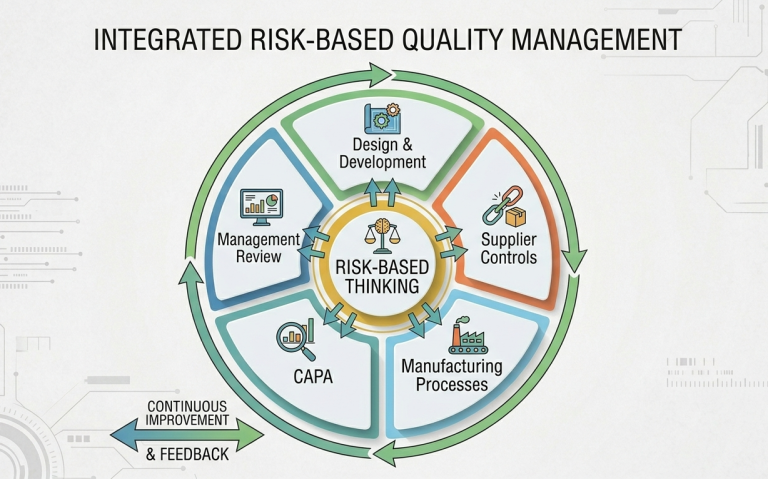
While ISO 13485:2016 Clause 4.1.2(b) has always required a risk-based approach to QMS processes, few organizations actually do it well. In a truly integrated system, risk considerations should be the primary driver behind decisions in manufacturing, supplier oversight, CAPA, and management review. QMSR (and CP 7382.850, by extension) is FDA’s way of pushing manufacturers out of their silos and toward a unified, system-wide strategy.
From Paperwork to Real-World Control
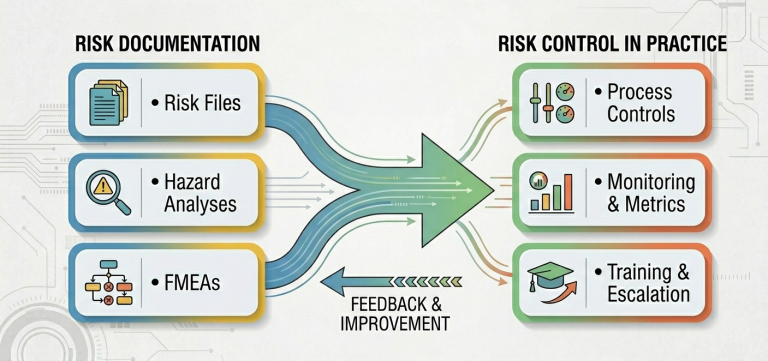
Most manufacturers have the basics: hazard analyses, risk files, and assessments. But QMSR asks a much tougher question: How do those assessments actually translate into day-to-day operations?
During an inspection, FDA will likely look for three things:
Traceability: Are your controls clearly linked to the risks you identified?
Implementation: Are those controls active where they actually matter (the shop floor, the lab, the warehouse, etc.)?
Sustainability: Are you monitoring these controls to see if they actually work over time?
If your identified design risks don’t trigger specific controls in production or supplier oversight, your risk management isn’t a tool – it’s a static exercise. When those connections are weak, it becomes nearly impossible to defend your rationale to an investigator.
Common Gaps: Why Systems Fail the “Risk Test”
As organizations audit their QMSR readiness, we consistently see the same four friction points:
The “silo” effect: Risk management is a in R&D but a ghost in manufacturing and purchasing. This creates a dangerous gap between what you know could go wrong and what you’re actually doing to prevent it.
Procedures without teeth: Many SOPs mention “risk-based thinking” in the introduction but offer zero guidance on how to actually apply it when making a high-stakes decision.
Disconnected CAPAs: Too many corrective actions fix the immediate symptom without ever circling back to the risk file. If a CAPA doesn’t force you to rethink your risk controls, you’re just waiting for the problem to happen again.
Static management reviews: Leadership often sees a wall of performance metrics but zero risk context. Without evaluating risk trends, management is just reacting to the past rather than addressing the future.
Proving Your Rationale to FDA
Under QMSR, “showing your work” means demonstrating how risk influences the path of the company. It’s about evidence, such as:
How you prioritize audits and resources based on risk
Adjusting controls for high-risk activities vs. low-risk ones
Employing escalation pathways that trigger automatically when risk thresholds are hit
This matters, because FDA is looking at maturity. When an investigator asks why you prioritized one issue over another, a vague answer won’t cut it. You need a risk-based rationale that is baked into the structure of your operations.
Rethinking Your Readiness
Preparing for QMSR is more than a mapping exercise – it requires a fundamental gut-check:
Where does risk truly drive our operations?
Can our teams actually explain why they make certain decisions?
Are our controls consistent, or are they applied differently depending on who is on shift?
How ELIQUENT Life Sciences Can Help
Moving from “documentation” to “demonstration” is a heavy lift. ELIQUENT Life Sciences helps manufacturers make that move through:
QMSR training: Translating abstract FDA expectations into practical, risk-based principles for your teams
Mock FDA inspections: Evaluating how your controls hold up under the pressure of a real-world audit
Gap remediation: Identifying where your risk integration is weak and helping you build a more resilient, defensible system
Identify and address weaknesses before an inspection puts them under the spotlight. Reach out to ELIQUENT Life Sciences to learn how we can support your transition to a mature, risk-driven QMS.