

QA/RA Consulting, Auditing & Training
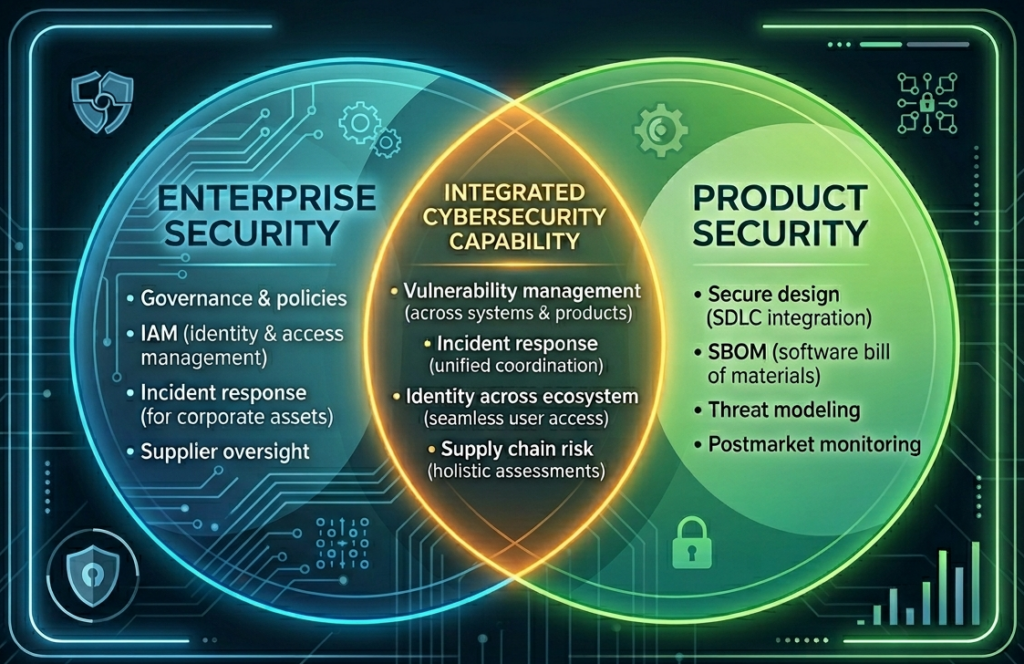
In reality, it operates across two distinct domains: enterprise security and product security. For years, these have evolved on parallel paths: different teams, different priorities, different tools. The assumption has been that alignment between them is helpful, but not essential.
That assumption is now outdated.
As devices become more connected, more software-driven, and more dependent on cloud ecosystems, the line between enterprise and product security is no longer just blurred, it’s increasingly irrelevant. What happens in one domain now directly impacts the other. Organizations that recognize this shift are starting to rethink how cybersecurity actually functions across the business.
Enterprise cybersecurity is fundamentally about protecting the organization. It includes governance structures, policies, risk management frameworks, identity and access management, incident response, and supplier oversight. Frameworks such as ISO/IEC 27001 and NIST CSF are typically applied here, with a focus on safeguarding data, infrastructure, and business operations.
Product security operates with a different focus. It is embedded within the design, development, and lifecycle management of the device itself. Activities such as secure architecture, threat modeling, developing a software bill of materials (SBOM), vulnerability management, patching, and postmarket surveillance are central. The stakes extend beyond protecting information – they include ensuring device integrity, clinical performance, and patient safety under real-world conditions.
Independently, both domains are necessary. In practice, neither is sufficient on its own.
The shift is not theoretical: it is already showing up in day-to-day operations. The connection points between enterprise and product security are becoming more visible and more consequential.
Vulnerability management is a clear example. A vulnerability identified in a third-party component does not stay neatly contained within a product context. If it is present in an SBOM, it is a product risk, but it can also expose enterprise systems, suppliers, or supporting infrastructure. Organizations that still manage vulnerabilities in silos often find themselves duplicating effort and reacting inconsistently, while those that align processes across domains are able to reduce response times and make more coherent risk decisions.
A similar shift is happening with identity and access management. What was once limited to users inside a corporate network now extends across connected devices, remote servicing capabilities, APIs, and cloud-based environments. The distinction between enterprise identities and product-level access controls is becoming harder to maintain, requiring a more integrated approach to identity across the entire ecosystem.
Incident response is also evolving. Cyberevents rarely stay contained within a single boundary. A product vulnerability can cascade into a hospital network and back into enterprise systems, while an enterprise breach can impact device functionality or data flows. Effective response increasingly depends on shared visibility, coordinated playbooks, and cross-functional ownership that spans engineering, quality, regulatory, and IT.
At the same time, software supply chain risk continues to expand. Modern medical devices rely heavily on open-source software, third-party components, cloud services, and external partners. Risk introduced at any point in this ecosystem can quickly become both a product and enterprise concern. Managing that risk requires more than point-in-time assessments – it depends on ongoing practices such as supplier evaluation, software composition analysis, and consistent SBOM governance throughout the lifecycle.
Regulatory expectations are evolving in ways that further connect these domains. There is increasing emphasis on cybersecurity as part of overall product safety and effectiveness, particularly in areas such as secure development, vulnerability management, and postmarket monitoring.
While specific requirements continue to evolve, the direction is clear. Product cybersecurity expectations increasingly depend on capabilities that have traditionally been owned at the enterprise level, such as supplier oversight, configuration management, incident response, governance, and training.
For many organizations, this creates a practical reality: product security cannot mature without enterprise capability behind it.
This shift is also being reinforced by broader regulatory momentum. Recent developments – including updates to quality system regulations, evolving global frameworks such as the EU Cyber Resilience Act, and regulatory action tied directly to cybersecurity vulnerability management – are signaling a more stringent and integrated approach to oversight.
At the same time, advances in artificial intelligence are lowering the barrier for identifying and exploiting vulnerabilities, thus accelerating the pace at which threats can emerge. In this environment, response timelines that once seemed reasonable (e.g., patch cycles measured in weeks) may no longer be sufficient.
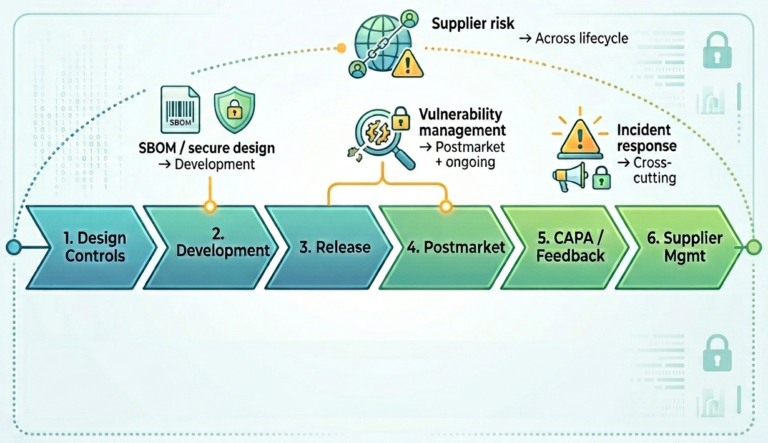
One of the most significant developments is where this convergence is taking place: within the quality management system (QMS).
Cybersecurity is no longer a stand-alone activity managed outside of core quality processes. It is being integrated into design controls, risk management, supplier management, CAPA, complaint handling, software maintenance, and postmarket surveillance. The QMS provides the structure needed to make cybersecurity activities repeatable, traceable, and continuously improved.
More importantly, it provides a common framework that connects enterprise discipline with product execution – something many organizations have historically struggled to achieve.
What is emerging is not simply better coordination, but a shift in operating model. Organizations that continue to treat enterprise and product security as separate tracks often encounter gaps, such as misaligned risk decisions, inconsistent processes, and fragmented ownership.
Those organizations making progress are taking a more integrated approach. They are aligning governance, establishing a shared language for risk, connecting tools and workflows, and clarifying accountability across functions. Engineering, quality, regulatory, and IT are no longer operating at the edges of cybersecurity – they are collectively responsible for how it is implemented and sustained.
Cybersecurity in medical devices is no longer just an IT concern, and it is no longer something addressed solely to satisfy regulatory expectations. It has become a core component of product quality, patient safety, and organizational resilience.
The organizations that are adapting most effectively are not necessarily the ones investing the most in individual tools or technologies. Instead, they are the ones closing the gap between enterprise discipline and product reality, treating cybersecurity as a connected capability that spans the full lifecycle and the full organization.
As enterprise security and product security continue to converge, many organizations are reassessing how cybersecurity is structured within their QMS and across the product lifecycle. ELIQUENT Life Sciences offers targeted medical device cybersecurity training along with advisory and consulting support in areas such as software lifecycle processes, risk management, supplier oversight, and quality system integration.
Learn more about ELIQUENT’s cybersecurity training and related services to support your organization’s approach.

US Office Washington DC

Lorem ipsum dolor sit amet, consectetur adipiscing elit. Ut elit tellus, luctus nec ullamcorper mattis, pulvinar dapibus leo.