

QA/RA Consulting, Auditing & Training
There comes a point in nearly every GLP audit where the checklist gives up on you: You’ve confirmed that the SOP exists. You’ve checked the signatures. You’ve triumphantly ticked the box for “procedure reviewed.” And yet… something feels off.
That’s because effective GLP auditing isn’t about proving that everything exists – it’s about figuring out whether everything actually works together. In other words: You’re not just checking boxes, you’re solving a mystery.
Let’s be fair, checklists are great. They keep audits consistent. They prevent obvious misses. They make you feel productive (“Only 12 boxes left!”).
But here’s the problem: A checklist can confirm that a document exists. It cannot tell you whether that document makes any sense in the real world.
GLP audits aren’t paperwork scavenger hunts. They’re evaluations of whether a study is planned, performed, monitored, recorded, and reported in a way that actually supports data integrity. That requires a different mindset.
Strong auditors don’t start with requirements or guidance documents – they start with curiosity. They ask:
Then strong auditors follow the trail:
Protocol → Execution → Raw Data → Review → Report → Archive
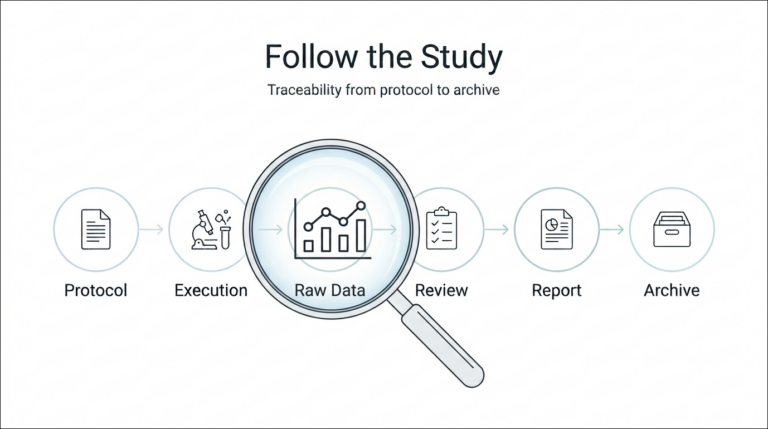
Think of this trail as the study’s storyline. Every conclusion in the final report should trace cleanly back to real, verifiable evidence. If that chain breaks, you don’t just have a documentation issue, you may have a data credibility issue. And no checklist in the world is going to fix that.
One of the biggest traps in auditing is assuming “If it’s documented, it must be fine.” But that’s not true. Real audit evidence comes from multiple places:
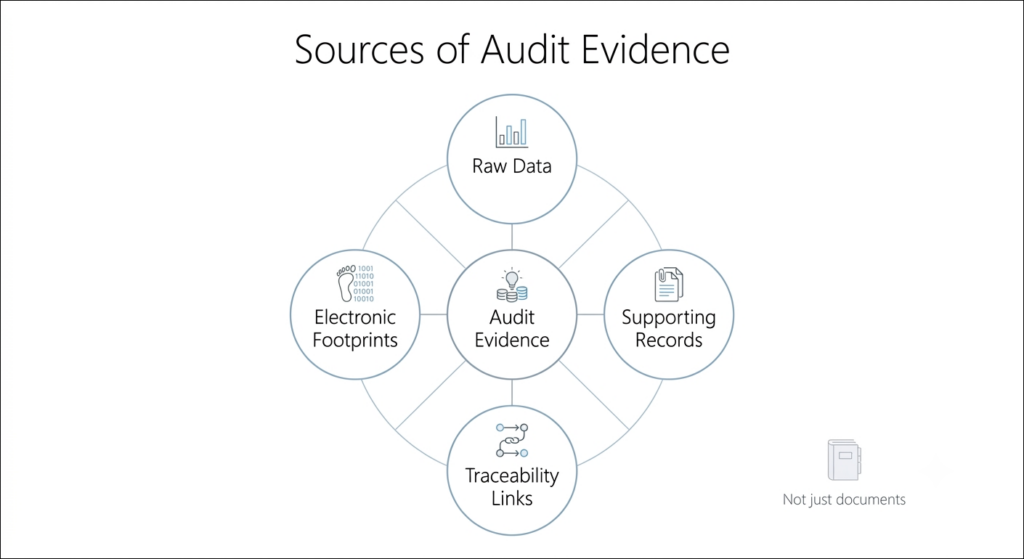
A single document rarely tells the whole story. Good auditors look for patterns, such as:
If everything lines up, that’s great. If it doesn’t, congratulations: you’ve just found where the real audit begins.
You can’t review everything (even if your inner perfectionist insists that you try). So yes, sampling is required. But effective sampling isn’t random – it’s intentional. Strong auditors zoom in on:
A checklist might ask: “Was calibration performed?” A great auditor asks: “How could calibration failure impact this study, and where would we actually see that?” That’s the shift: from checking activity to understanding impact.
Here’s where audits often fall apart. Even when documentation looks solid, many audits stop at: “What happened?” Effective auditors go further: “Why did it happen this way and was that decision appropriate?”
GLP is full of decisions:
Because of this, each decision should leave a trail:
If not, you’re not just missing paperwork – you’re missing the reasoning that supports the study’s integrity.
Documents tell you what should happen. People tell you what actually happens. That’s why interviews are where audits get interesting. A simple question can reveal:
These moments are gold, not because something is “wrong” but because you’re finally seeing how the system truly operates.
Let’s clear something up: A missing signature is not the same as missing raw data. Effective auditors don’t just list findings, they prioritize them based on risk and impact by asking questions like:
Because the goal of an audit isn’t to generate a long list; rather, it’s to generate insight that actually matters.
Moving beyond the checklist doesn’t mean throwing it away. It means using the checklist … and then going further. It’s the difference between “Did I check everything?” and “Do I actually understand what happened here?” That shift turns auditing from a task into a skill – and from a compliance exercise into something genuinely valuable.
At its core, a GLP audit is storytelling. You’re piecing together:
And then asking one critical question: Does the evidence support the ending (a compliant system)? The checklist might help you get started, but evaluating the evidence that determines what the story really shows? That’s up to you.
If you’re looking to strengthen your approach to GLP auditing – from evidence evaluation to risk‑based thinking, and everything in between – ELIQUENT Life Sciences offers training and consulting services related to internal auditing, inspection readiness, and quality systems to support more effective, insight‑driven audits.

US Office Washington DC

Lorem ipsum dolor sit amet, consectetur adipiscing elit. Ut elit tellus, luctus nec ullamcorper mattis, pulvinar dapibus leo.