

QA/RA Consulting, Auditing & Training
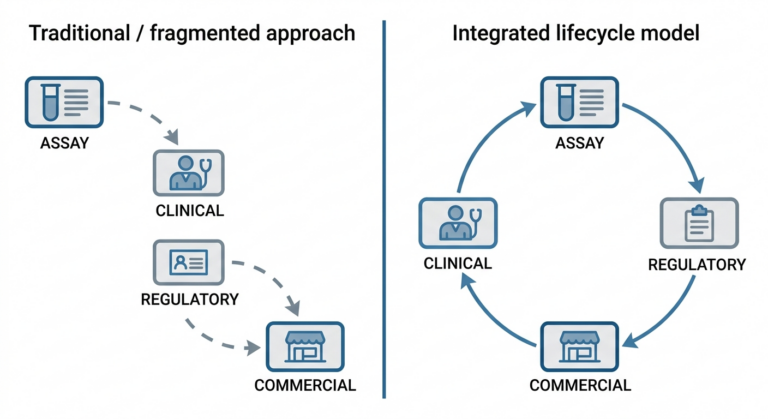
Across pharmaceutical and in vitro diagnostics (IVD) organizations, the same questions continue to be asked related to precision medicine:
These questions are often asked of regulatory teams or consultants. In practice, they are enterprise decisions that directly influence development timelines, evidence integrity, lifecycle continuity, launch readiness, reimbursement strategy, physician adoption, operational scalability, and long-term platform value.
Precision medicine is no longer simply a biomarker matter; it is increasingly a systems integration challenge requiring organizations to connect scientific, operational, regulatory, clinical, digital, and commercial capabilities into unified enterprise ecosystems. This is reflected across regulatory guidance, companion diagnostic co-development frameworks, quality system modernization efforts, and the growing use of integrated multiomics and real-world evidence strategies throughout drug development and post-market surveillance processes.
The future of precision medicine will increasingly depend on MOSAIC platforms: multiomic operational systems and integrated connectivity frameworks designed to integrate biological insight, regulatory continuity, quality systems, software infrastructure, clinical execution, and lifecycle learning into adaptive enterprise ecosystems.
Many of the most significant precision medicine challenges do not originate during commercialization. Instead, they start much earlier, when organizations make isolated development decisions without considering downstream lifecycle consequences.
Investigational assays, LDTs, and technologies originating from RUO environments may be used within appropriately governed clinical investigation frameworks depending on study objectives, patient risk, intended use, and applicable investigational device considerations. FDA guidance recognizes that certain investigational IVD studies may qualify for exemptions from portions of IDE requirements under specific conditions, including when testing is noninvasive, does not introduce significant risk, and is not used as a stand-alone diagnostic without confirmation by another medically established diagnostic procedure. However, IRB oversight, informed consent requirements, investigational labeling, and broader human subject protections may still apply.
Importantly, once assay results begin prospectively influencing the following, the assay becomes tightly linked to the broader development and market access pathway:
At that point, questions surrounding intended use, analytical validity, specimen integrity, software governance, assay reproducibility, bridging strategy, operation scalability, and commercialization readiness become enterprise-level concerns rather than isolated technical decisions. Historically, diagnostics were often treated as downstream support functions within therapeutic development programs. However, precision medicine and companion diagnostic co-development increasingly demonstrate that diagnostic strategy directly influences:
The consequence is clear: isolated decisions made at one stage of development can create fragmentation and “leakage” across the entire precision medicine ecosystem. (“Leakage” refers to the loss of continuity, evidence integrity, or strategic alignment as information, accountability, or decision making passes across disconnected functions, systems, vendors, technologies, or lifecycle stages.)
Leakage appears in multiple forms:
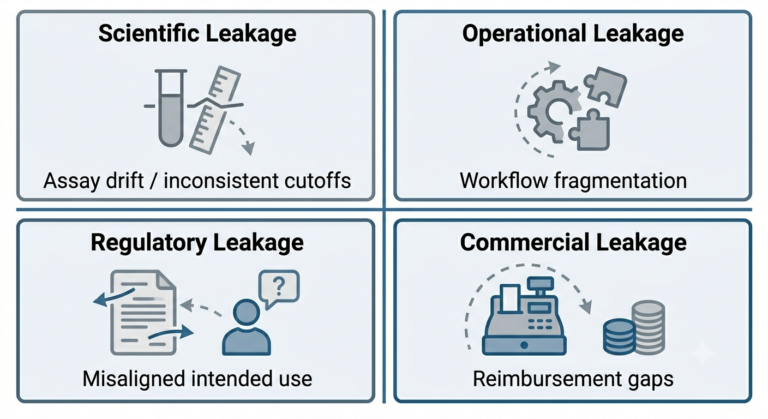
Every disconnected interface introduces friction. Every friction point weakens continuity, scalability, operational efficiency, and long-term enterprise value. This is particularly true when pharmaceutical and IVD regulatory strategies evolve independently rather than through coordinated lifecycle planning. Precision medicine programs increasingly require an aligned regulatory strategy across therapeutic and diagnostic development, including intended use definition, analytical validation planning, clinical evidence generation, labeling strategy, software governance, change management, and global submission sequencing. When these activities are managed separately, organizations increase the risk of evidence fragmentation, delayed approvals, bridging requirements, commercialization misalignment, and downstream operational inefficiencies. Successful precision medicine programs increasingly depend on integrated regulatory planning frameworks that connect pharmaceutical and IVD development strategies from early biomarker identification through post-market lifecycle management.
Late diagnostic integration creates downstream friction. One of the most common historical challenges in companion diagnostic development has been delayed integration of diagnostics into therapeutic development programs. Regulatory agencies, industry groups, and co-development case studies have repeatedly demonstrated that late-stage diagnostic integration can contribute to:
The industry has increasingly recognized that precision medicine strategy must begin early and evolve continuously alongside therapeutic development rather than being added after the fact.
Assay evolution introduces lifecycle risk. Many development programs initially relied on exploratory assays without fully considering long-term continuity across clinical phases and commercialization. As programs matured, platforms changed, software pipelines were updated, specimen assumptions shifted, and laboratory workflows were modified. These changes frequently introduced data non-comparability, analytical uncertainty, bridging burdens, operational delays, and regulatory scrutiny. FDA and global regulatory agencies have increasingly emphasized lifecycle management, analytical consistency, software change governance, and traceability throughout diagnostic development and post-market modification processes. The lesson is not simply that assays require validation, but also that lifecycle continuity matters just as much.
Functional silos increase operational leakage. Historically, regulatory affairs, quality, clinical operations, bioinformatics, laboratory operations, medical affairs, commercial, and real-world evidence functions often operated through sequential handoffs. This fragmented structure created operational inefficiencies across development programs. As noted previously, operational leakage represents the loss of value, continuity, evidence integrity, or strategic alignment as information, accountability, or decision making moves across disconnected systems, functions, vendors, technologies, or lifecycle stages. While “operational leakage” is not currently a formal regulatory term, the underlying issues are well recognized across:
This concept aligns with broader industry movement toward:
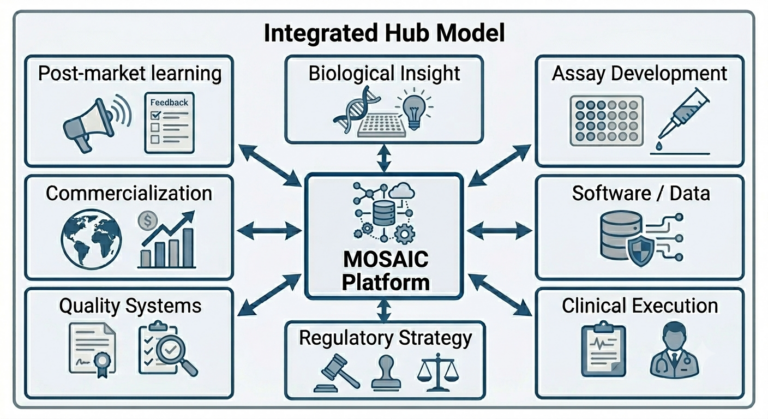
Precision medicine is evolving from a technology matter into a systems integration challenge. The next generation of competitive advantage will belong to organizations creating a connected MOSAIC platform for a functional integrated ecosystem. The future will not be defined by isolated assays, isolated departments, or isolated partnerships: it will be characterized by MOSAIC ecosystems designed to preserve continuity, reduce operational leakage, accelerate learning, and amplify value across the full precision medicine lifecycle.
ELIQUENT helps manufacturers address various aspects of the product lifecycle through:
Reach out to ELIQUENT Life Sciences to learn how we can help you successfully manage the product lifecycle with confidence.

US Office Washington DC

Lorem ipsum dolor sit amet, consectetur adipiscing elit. Ut elit tellus, luctus nec ullamcorper mattis, pulvinar dapibus leo.