

QA/RA Consulting, Auditing & Training
Software traceability shows how a product idea becomes tested and approved software by connecting intended use and requirements with design, risks, test results, known issues, and the release decision.
For software used in or as a medical device, US and European regulators expect evidence of controlled development as well as safety and effectiveness for intended use, including documented requirements, risk management, testing, change control, and release records. The goal is not a perfect spreadsheet, but rather a clear development story supported by reliable evidence.
This evidence chain supports IEC 62304:2006+A1:2015 (Medical Device Software – Software Life Cycle Processes). The standard builds traceability through connected lifecycle activities: planning, requirements, architecture and design, implementation, verification, integration and system testing, release, maintenance, risk management, configuration management, and problem resolution.
The connected lifecycle activities form a traceability matrix that helps demonstrate that the team can link:
The same evidence supports broader regulatory expectations. The FDA Quality Management System Regulation (QMSR), effective February 2, 2026, aligns the US quality-system framework with ISO 13485:2016, whose design controls require planned activities, documented inputs and outputs, verification, validation, controlled changes, and maintained records. In the EU, this evidence supports technical documentation showing conformity with applicable safety and performance requirements. The matrix is not the requirement itself; it demonstrates that lifecycle activities and decisions are connected, controlled, and supported by objective evidence.
Traceability is the thread connecting requirements, architecture and design, risk assessment, implementation, verification, and validation. For each requirement, the team should be able to show:
Clear connections turn traceability into useful evidence, rather than being a just spreadsheet built only to satisfy an expectation.
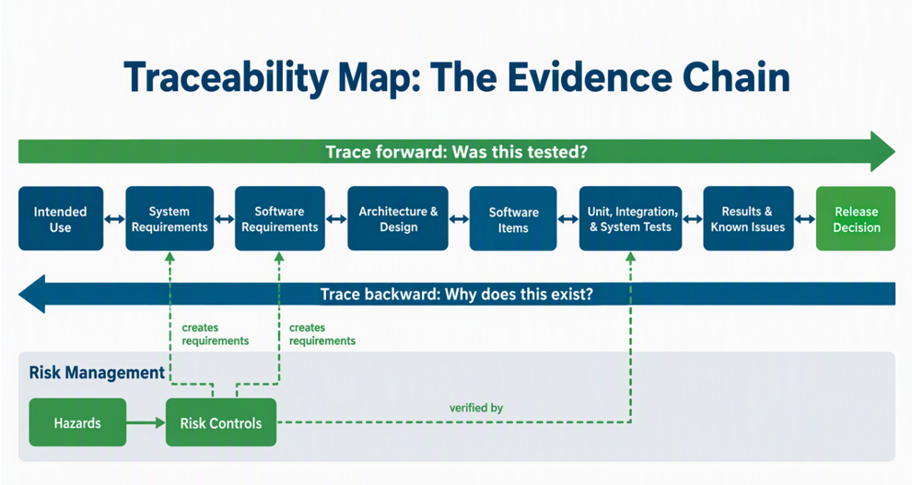
A traceability map makes the evidence chain visible, showing where each artifact fits and where change impact should be reviewed.
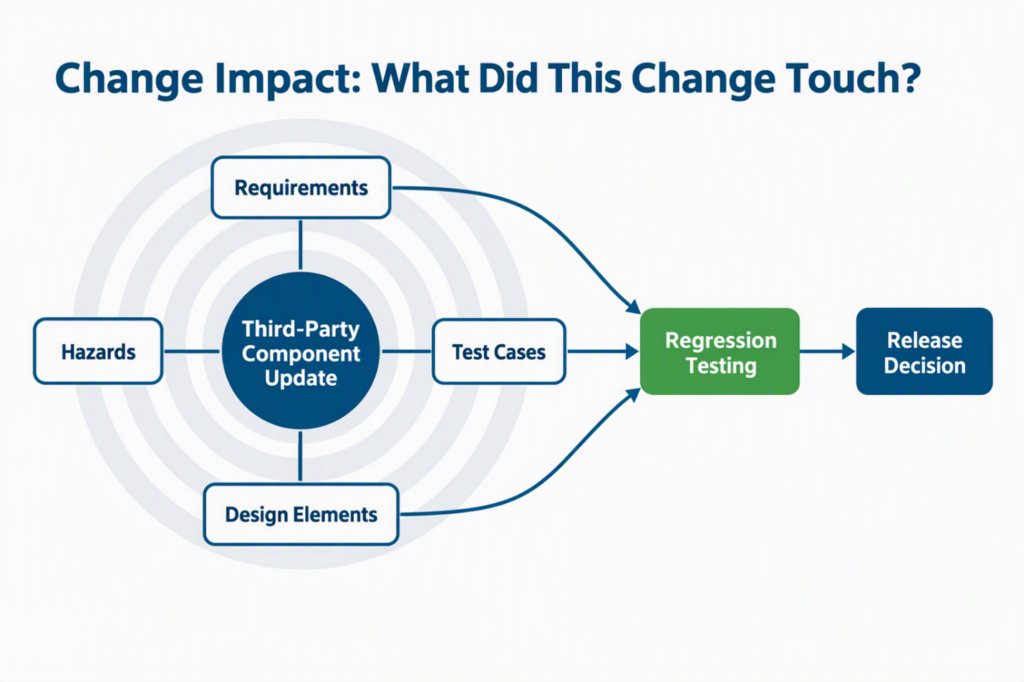
Traceability gaps often surface during audits, regulatory reviews, defect investigations, change assessments, or release decisions. A defect correction, feature, third-party component update, security fix, or platform change can affect requirements, risks, design, and testing – not just code.
After a routine update, the central question is: “Which requirements, hazards, design elements, and test cases were affected by this change?”
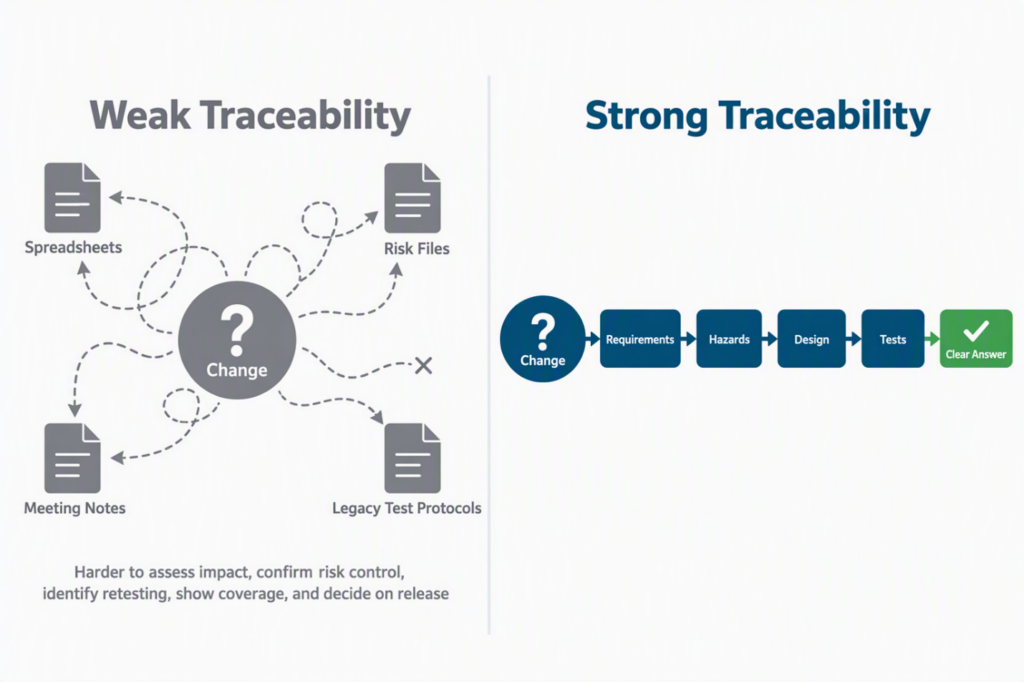
Without strong traceability, the answer may require searching requirements, risk files, design records, test protocols, meeting notes, and legacy spreadsheets. Weak traceability makes it harder to:
Traceability can be assembled at the end – just as a jigsaw puzzle can be finished after pieces migrate under the couch – but it should begin before records scatter across tools, teams, and timelines.
Plan the evidence trail early so information remains accurate, aligned, and useful throughout the product lifecycle. This makes changes easier to assess and explain as the product evolves.
Before release, review traceability for completeness, accuracy, and consistency – not merely filled cells. Verify that:
Coverage percentages can expose gaps but cannot replace careful review. A fully linked matrix is still weak if requirements are vague, tests are limited, or safety controls were not challenged realistically.
Good traceability supports design reviews, changes, defect investigations, submissions, assessments, and post-release actions by showing what changed, what was affected and retested, and why remaining risk was acceptable.
Strong traceability does not eliminate risk, prevent every defect, or replace engineering judgment. Instead, it provides visibility into change impact, risk control, verification coverage, and release readiness. It also gives development, quality, regulatory, cybersecurity, and project teams a shared basis for decisions affecting patient safety, compliance, and release.
Mature organizations use the matrix as a working tool to see what changed, what may be affected, and where follow-up is needed – not as a finish line. Used this way, traceability helps teams answer difficult questions before they become urgent, expensive, or disruptive.
ELIQUENT Life Sciences provides training and consulting services in medical device software development, risk management, design controls, verification and validation, and implementation of quality systems. ELIQUENT can help build a practical, defensible traceability approach that works throughout the entire product lifecycle, not just during audit week. Learn more about ELIQUENT Life Sciences’ training and consulting services.

US Office Washington DC
