

QA/RA Consulting, Auditing & Training

Most complaint-handling failures do not begin when an investigation is missed. Instead, they start earlier, at the moment when no one realizes they are looking at a potential complaint. For example, a customer mentions an unusual product issue during a support call, or a service technician hears a similar concern while replacing a device, or a sales representative receives feedback during a customer visit.
The immediate problem gets fixed, the customer moves on, and the interaction is documented as routine. Months later, those routine interactions may emerge as the first visible signs of a larger product or quality issue.
This challenge cuts across the medical device industry. Organizations invest heavily in complaint-handling procedures, investigations, trend analysis, and reporting. Yet many still struggle with a more fundamental challenge: recognizing potential complaint signals before they ever enter the complaint-handling process.
The solution is rarely another procedure, form, or database. More often, it starts with a simple realization: complaints rarely arrive labeled as complaints.
Customers don’t usually describe product issues using technical complaint terminology. Instead, they describe what happened, what they needed, or what got in the way of completing their work.
The customers may be focused on getting a replacement, understanding an unexpected event, resolving confusion with instructions, or preventing the same issue from happening again. They are not usually thinking about internal quality processes, regulatory definitions, or whether their concern meets a formal complaint threshold.
A clinician may mention that a device shut down unexpectedly, but then quickly add that another unit was available. A customer may request replacement product without focusing on the event that led to the request. A user may say a step was confusing rather than describe it as a usability concern. The language may sound ordinary, but the underlying signal may still matter.
The first job is not to decide whether the information is officially a complaint – it is to notice when everyday customer language may contain a signal that deserves to be captured and routed for review.
Once a potential signal is heard, a second risk appears: employees may try to decide, in the moment, whether it is important enough to escalate.
The instinct is understandable. No one was harmed. The customer seemed unconcerned. The issue looked like a routine service request. The product was replaced, the immediate need was met, and the interaction appeared complete.
That is often the moment when important information gets filtered out and the signal disappears. Employees may not intend to withhold anything; they may simply be trying to be practical and efficient. In doing so, they can unintentionally screen out details that complaint-handling personnel need to evaluate.
The frontline role is to capture and route, not to diagnose and decide. Questions such as “Was this user error?” or “Was anyone hurt?” may be important, but they are not questions that frontline personnel should answer on their own. Those determinations belong to trained complaint-handling personnel. When early judgment happens too soon, the organization may never see the full picture.
One of the biggest blind spots in complaint handling is where information first appears.
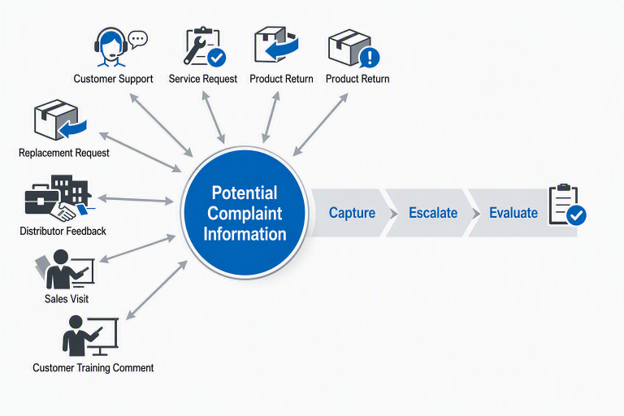
It is easy to picture a complaint arriving through a complaint mailbox or a formal customer complaint form. But in day-to-day operations, useful information often appears in less obvious places: a service call, a replacement request, a product return, a distributor conversation, a customer training session, a sales visit, a packaging discussion, or a casual piece of customer feedback.
A replacement request may look administrative. Look closer, though, and it may contain the first mention of an error message, an unexpected shutdown, a performance concern, or a usability concern.
By itself, that detail may seem insignificant. Combined with similar reports, it can become the first sign of a trend.
Complaint identification is not just a responsibility of the Quality department. Any team that interacts with customers may be the first to encounter information that deserves further review.
Consider a service request that seems ordinary at first. A customer reports that a monitor shut down unexpectedly during use. There is a backup unit nearby, no one is harmed, and Customer Support quickly arranges a replacement.
From the outside, the issue appears resolved. The customer’s immediate need is met, the replacement is documented, and the case is closed.
Then the same kind of shutdown starts appearing in other service records. One request looks routine. Several similar requests tell a different story. What once looked like a simple replacement may now point to an emerging reliability issue that needs evaluation. That story is only visible if the original details are captured, connected, and evaluated instead of remaining scattered across service records, emails, replacement logs, or customer notes.
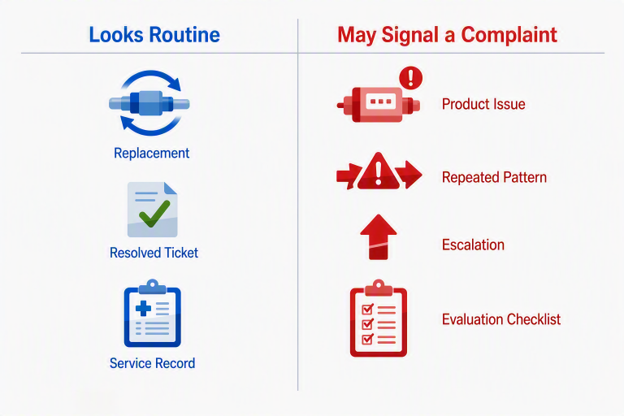
Complaint handling is often viewed primarily as a compliance activity. That perspective misses part of its value, because complaint handling is also one of the best ways an organization learns how its products perform in the real world.
Once products leave controlled development and testing environments, real-world use begins to reveal new information. Users adapt products to local workflows. Conditions vary. Practical challenges appear that may not have been visible before release.
Complaint information helps turn individual observations into organizational knowledge. It can reveal recurring concerns, usability challenges, product performance issues, and opportunities for improvement. Complaints are more than records of problems; they are field intelligence.
Strong organizations do not rely on employees to recognize complaints perfectly. Instead, they build systems that make potential concerns easier to recognize, capture, and escalate.
Employees know what information to capture, when to escalate it, and where it should go next, and they learn the difference between gathering facts and drawing conclusions. Incomplete information is rarely a reason to wait. In many cases, uncertainty is exactly why information should be escalated.
Most important, responsibilities remain clear. Frontline personnel capture information, whereas complaint-handling professionals evaluate significance, determine next steps, and assess reportability. This separation helps ensure that potential signals reach the people responsible for evaluating them.
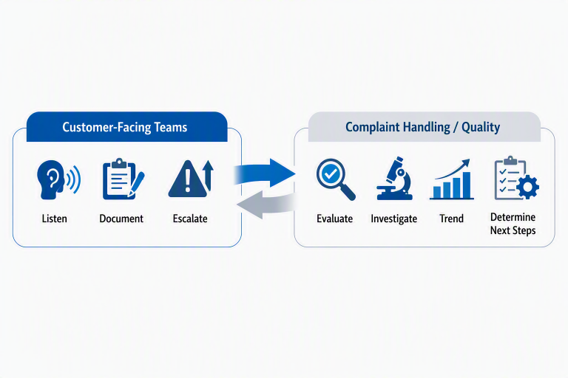
The most important complaint your organization receives may never contain the word complaint. It may arrive as a replacement request, a support question, a distributor observation, a packaging concern, or a casual comment made during a training session. The signal may be easy to miss until similar information begins to appear elsewhere.
Organizations that identify risks early recognize that valuable information is often incomplete, informal, and easy to overlook. Rather than waiting for certainty, they create processes that allow potential concerns to be evaluated before patterns are missed.
In complaint handling, the first opportunity to protect patients, users, and product quality often begins with a simple act:
Recognizing the complaint that nobody called a complaint.
The difference between a routine customer interaction and an actionable complaint signal is not always obvious. Building awareness across customer-facing functions can help organizations capture important information before it is lost.
Learn more about ELIQUENT Life Sciences’ training and consulting services related to complaint handling, CAPA, quality systems, auditing, and post-market activities.

US Office Washington DC

That’s fine for low-risk work, but it’s harder to defend when:
Lorem ipsum dolor sit amet, consectetur adipiscing elit. Ut elit tellus, luctus nec ullamcorper mattis, pulvinar dapibus leo.