logo

QA/RA Consulting, Auditing & Training

logo

Let's get started

Navigating the FDA QMSR Transition: Insights for Compliance

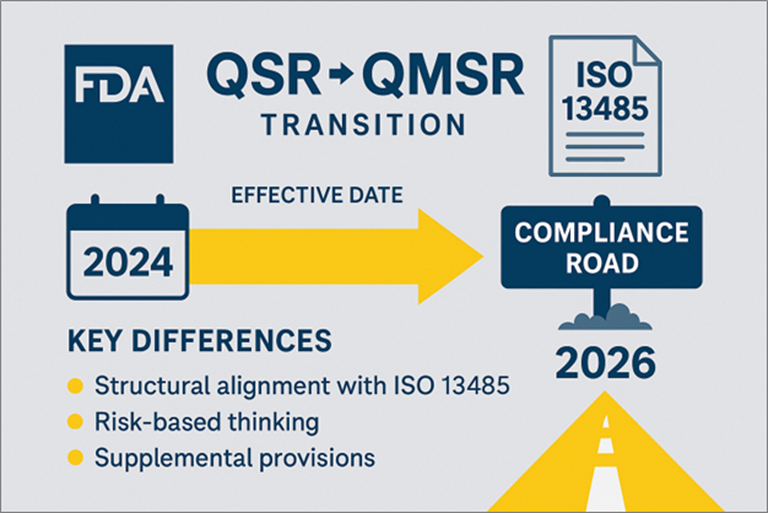
QSR to QMSR Transition

(5-Part Microlearning Video Series)

Audience: Medical device professionals, quality managers, and compliance teams

Why You Should Care (Yes, You)

The FDA has officially moved on from its 25‑year‑old QSR, replacing it with the ISO 13485‑aligned QMSR. That shift isn’t theoretical anymore—it’s enforceable, and inspection expectations have changed accordingly.

Video 1 – From QSR to QMSR: What’s Changing and Why It Matters

Watch time: 3 min In this video
  • What is QMSR? A wholesale rewrite of 21 CFR Part 820 aligning US CGMP with ISO 13485:2016—plus a few FDA-specific tweaks to keep lawyers happy.
  • Why ISO 13485? Harmonization eliminates duplicate audits, smooths global market entry, and lets FDA leverage an already mature standard.
  • Timeline you can’t ignore:
    • Final rule published – 31 Jan 2024
    • Effective date – 2 Feb 2026 (two-year implementation)
    • Your action plan: gap analysis → remediation → internal audits → management review → sleep better at night
Pro tip: Start training ops and suppliers now—nobody ever complained that they were “too ready” for an FDA inspection.

Video 2 – QMSR Structure & Compliance

Watch time: 3 min In this video
What Changed Why It Matters
Structure swapped from subpart-heavy QSR to ISO 13485 clause order Your QMS manual can finally look the same on both sides of the Atlantic
Risk-based thinking baked in FDA expects risk management throughout the product life cycle, not bolted on at the end
Supplemental provisions (complaint handling, traceability, servicing) These FDA-only add-ons keep “US market” nuances intact
Terminology update (e.g., “device master record” ≈ ISO’s “medical device file”) Less glossary juggling for global teams
Documentation flexibility If ISO 13485 lets you, do it digitally, FDA will too – just keep those records easily retrievable

5-Step Action Checklist

  1. Gap analysis – Map every ISO 13485 clause (and FDA extras) to your current procedures
  2. Risk files refresh – Align with ISO 14971; regulators read ISO 13485 and ISO 14971 side by side
  3. Supplier requalification – Ignorance isn’t bliss; suppliers are in scope.
  4. Training blitz – Quality isn’t a silo sport – get ops, RA/QA, and exec teams speaking QMSR
  5. Mock FDA audit – Fix the warts while the lights are off

Video 3 – QMSR Risk Management Requirements

Watch time: 2 min In this video What you need to know Risk management is no longer just a design-phase requirement – under QMSR and ISO 13485, it must be integrated across the entire product life cycle. Learn what this shift means and how to stay compliant by 2026. As FDA transitions from QSR to QMSR, risk management is no longer just a box to check during design; it must be embedded throughout the entire product life cycle. This video breaks down what this shift means, how ISO 13485 and ISO 14971 factor in, and what steps manufacturers need to take to stay compliant by 2026.

Video 4 – Preparing for QMSR

Watch time: 2 min In this video Are you ready for the new records requirements in QMSR? If you’re still thinking it’s just business as usual, think again. The updated regulation introduces new expectations around:
  • Complaint and servicing records
  • UDI inclusion in multiple record types
  • Confidentiality markings for FDA submissions
These changes aren’t just technical updates – they’re strategic. Marking records as confidential helps protect your proprietary info. Including UDI across documents improves traceability. And is it ready for the inspection? That’s non-negotiable.
  • Continuous compliance isn’t optional
  • Being prepared can make or break your next inspection
Navigate QMSR with clarity, not confusion. Let’s get the inspection ready together.

Video 5 – QMSR – Process Meets Control

Watch time: 2 min In this video How do process thinking and risk controls drive better quality systems? In our latest video, we break down two core pillars of QMSR (Quality Management System Regulation) for medical devices: the process approach and risk-based controls. You’ll learn how the PDCA cycle helps teams plan, execute, and improve processes, and how risk-based thinking ensures consistency, accuracy, and regulatory alignment. Whether you’re in quality, regulatory, or operations, this is a quick, clear look at what makes a QMS truly effective. Watch now to see how these concepts come together for stronger compliance and smarter systems.

Keep the Conversation Going

We invite you and your team to register for one of these courses offered by ELIQUENT Life Sciences for in-depth expansion:

If you find the videos helpful, share this post with a colleague who’s still clinging to the old QSR like it’s vinyl in a Spotify world. 

Our team is here to help. Contact us online
or
Get answers right now. Call

US OfficeWashington DC

1.800.472.6477